Notebook summary
Principle. The network predicts each time bin from the last \(D\) bins of activity only (the spiking motif window), \(s(t) = f\big(s(t-D), \dots, s(t-1)\big)\), where \(D\) = num_delay (41 bins of 1 ms) and \(s^*\) = frozen_target is the motif of \(T\) = N_time bins (1000 bins). The motif is made periodic by copying its first \(D\) bins onto its last \(D\) bins:
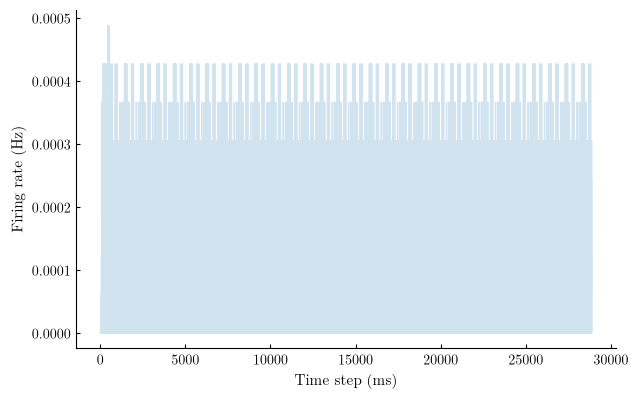
Training on a single motif covers the \(P\) transitions \(t \in [D, T)\), which are exactly all the transitions of a cycle of period \(P\), including the one that wraps the end of the motif back onto its beginning. Once the network reaches the end of the motif, the window of its last \(D\) bins is therefore identical to the trigger window, so it replays \(s^*(D), s^*(D+1), \dots\) again: the polychronous chain closes on itself and the motif becomes a self-sustained cycle.
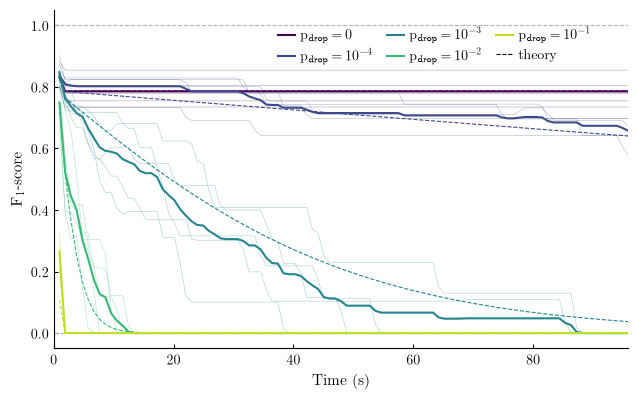
Retrieval is then tested over N_repeat = 30 consecutive periods after a single trigger window, and the last sweep measures, through the F1 score of each of N_period = 100 periods of free replay, how long the cycle survives when each emitted spike fails to reach the recurrent input with probability \(p_\mathrm{drop}\).
This notebook trains MNESIS/HD-SNN on periodic spike patterns and evaluates robustness to input perturbations.
Pipeline
Load the shared setup from
mnesis_boilerplateandmnesis_chains.Build
PeriodicSpikingPattern: Bernoulli target (p_A) with periodic boundary copy overnum_delaybins; as aStochasticSpikingPattern, each call returns a balanced-flip realisation (p_flip).Instantiate
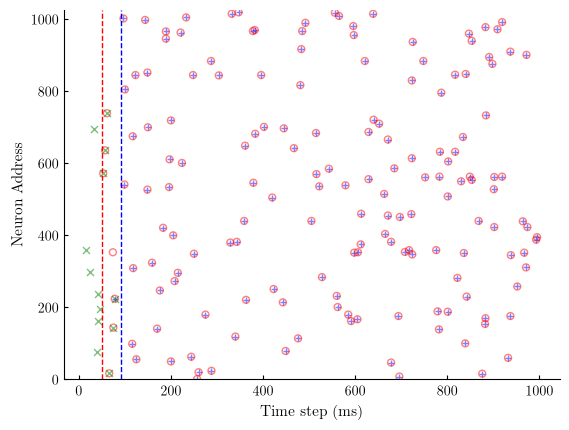
Params+HD_SNN, then load or train and cache{datetag}_{exp}.pth(with lock file).Evaluate one-period retrieval (precision, recall, F1) and plot raster diagnostics.
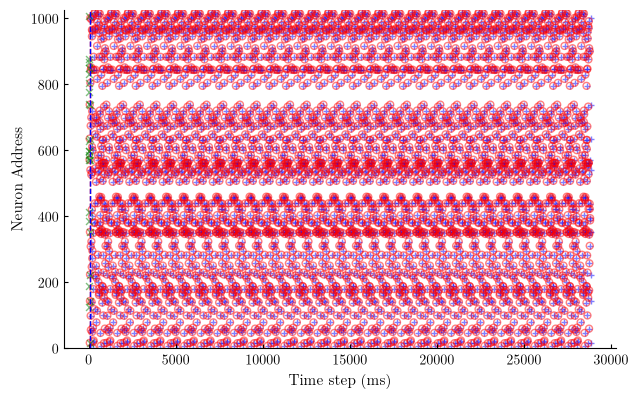
Evaluate long-horizon retrieval over repeated periods (
N_repeat).Same long-horizon retrieval in a second cache (the
flip_bits(..., 0.323)perturbation is commented out, so the trigger is clean).Sweep the transmission failures (
p_drop, 0 then log-spaced from 1e-4 to 1e-2,N_scan= 5 levels,N_cv= 5 seeded realisations): one noisy trigger, thenN_periodperiods (ofN_time - num_delaybins) of free replay with failures, each period scored against the frozen target (precision, recall and F1,scores_np, shape(N_scan, N_cv, N_period, 3)), and compared with the survivalexp(-h t)predicted byget_replay_hazard.
Main outputs
Model checkpoint:
{datetag}_{exp}.pth.Optional cached spikes: clean/noisy periodic retrieval tensors.
Failure-sweep cache:
{datetag}_{exp}-drop_N_scan={N_scan}_N_cv={N_cv}_N_period={N_period}.npz(p_drop,scores_np,n_done).Metrics and plots: precision/recall/F1, rasters, and F1-vs-period trajectories.
[1]:
from mnesis_boilerplate import torch, np, plt, splt, data_cache, cache_lock, RECOMPUTE, Params
from mnesis_boilerplate import printfig, get_scores, get_f1_from_ignition, get_replay_hazard, trange
from mnesis_chains import HD_SNN, StochasticSpikingPattern
# RECOMPUTE = True
exp = 'periodic'
datetag = '2026-09-07'
Using device: mps
working memory with periodic targets
Setting up:
[2]:
# (p_flip) as notebook 11; the periodic wrap is restored after each realisation.
class PeriodicSpikingPattern(StochasticSpikingPattern):
    def __init__(self):
        super().__init__()
        self.desc = "Periodic pattern generator"
        self.is_periodic = True

    def init(self, opt, verbose=False):
        self.opt = opt
        frozen_target_generator = torch.Generator()  # used once to generate the target pattern
        frozen_target_generator.manual_seed(opt.seed)
        p_bias = opt.p_A * torch.ones((opt.N_pattern, opt.N_neuron, opt.N_time))
        self.frozen_target = torch.bernoulli(p_bias, generator=frozen_target_generator)
        self.frozen_target = self.frozen_target.float()
        self.frozen_target = self.frozen_target.to(opt.device)
        if verbose:
            print(f"Target pattern generated with shape {self.frozen_target.shape} and mean {self.frozen_target.mean().item():.3e}")

        # Make the target periodic by copying the first opt.num_delay time steps to the end of the sequence
        # such that the polychronous chain is virtually endless
        self.frozen_target[:, :, (-opt.num_delay):] = self.frozen_target[:, :, :opt.num_delay]

    def __call__(self, seed=None, verbose=False):
        realisation = super().__call__(seed=seed, verbose=verbose)
        # keep the chain endless: the last num_delay bins repeat the first ones
        realisation[:, :, (-self.opt.num_delay):] = realisation[:, :, :self.opt.num_delay]
        return realisation
[3]:
opt = Params()
hd = HD_SNN(opt, PeriodicSpikingPattern())
hd.net.to(hd.opt.device)
hd.pattern_object().shape, opt
[3]:
(torch.Size([16, 1024, 1000]),
 Params(datetag='2026-09-07', N_neuron=1024, num_delay=41, N_pattern=16, N_time=1000, N_pretime=50, p_A=0.00016, p_flip=0.01, seed=2026, lif_beta=0.7, lif_threshold=0.75, learn_beta=False, learn_threshold=False, do_pinv=True, do_deconv=True, num_epochs=256, num_warmup_epochs=16, base_lr=0.04, final_lr=0.0004, delta1=0.003, delta2=1e-05, dropout=0.6, alpha_surrogate=5.0, surrogate_name='FastSigmoid', loss_name='SpikeF1scoreLoss', reset_mechanism='zero', optimizer='adadelta', verbose=False, fig_width=15.92, phi=1.61803, fig_height=9.839125356142963, N_time_show=1000, N_neuron_show=1024, i_pattern=1, N_scan=14, N_cv=11))
Learn the periodic target
[4]:
model_filename = data_cache / f"{hd.opt.datetag}_{exp}.pth"
lock_filename = model_filename.with_suffix('.lock')
if RECOMPUTE:
    model_filename.unlink(missing_ok=True) # FORCING RECOMPUTE
    lock_filename.unlink(missing_ok=True) # FORCING RECOMPUTE
try:
    model_state_dict = torch.load(model_filename, map_location=torch.device(hd.opt.device))
    hd.net.load_state_dict(model_state_dict)
    hd.net.eval()
    lock_filename.unlink(missing_ok=True) # in case the lock file was not unlinked
    print(f"Model weights loaded from {model_filename}") # Add a log message
except FileNotFoundError:
    with cache_lock(model_filename) as acquired:
        if acquired:
            print(f"Model file not found: {model_filename}, inititializing and learning the new model.")
            ##################
            hd.update_weight()
            hd.learn_model()
            ##################
            torch.save(hd.net.state_dict(), model_filename)
        else:
            print(f"Model file is locked: {lock_filename}, passing.")
Model weights loaded from ../cached_data/2026-09-07_periodic.pth
[5]:
with torch.no_grad():
    target = hd.pattern_object.frozen_target # noise-free reference, scored against
    cue = hd.pattern_object(seed=hd.opt.seed) # seeded noisy realisation, provides the trigger
    target_full = torch.nn.functional.pad(target, (opt.N_pretime, opt.N_pretime))
    input_spikes = hd.get_input_spikes(target=cue, seed=hd.opt.seed)
    _, _, spikes = hd.forward_pass(input_spikes)
    spikes_evoked = spikes[:, :, (hd.opt.N_pretime+hd.opt.num_delay):(hd.opt.N_time+hd.opt.N_pretime)]
    target_evoked = target[:, :, hd.opt.num_delay:]

    precision, recall, f1_score = get_scores(spikes_evoked, target_evoked)
    print(f'precision = {precision:.3f}\t recall = {recall:.3f}\t f1_score = {f1_score:.3f} ')
precision = 0.828 recall = 0.826 f1_score = 0.827
[6]:
fig, ax = plt.subplots()
splt.raster(spikes[opt.i_pattern, :opt.N_neuron_show, :opt.N_time_show].T, ax, s=25, c="blue", marker='+', alpha=.5)
splt.raster(target_full[opt.i_pattern, :opt.N_neuron_show, :opt.N_time_show].T, ax, s=25, facecolor='none', edgecolor='red',  marker='o', alpha=.5)
splt.raster(input_spikes[opt.i_pattern, :opt.N_neuron_show, :opt.N_time_show].T, ax, s=25, c="green", marker='x', alpha=.5)
ax.vlines([opt.N_pretime], 0, opt.N_neuron_show, 'r', ls='--')
ax.vlines([opt.N_pretime+opt.num_delay], 0, opt.N_neuron_show, 'b', ls='--')
ax.set_xlabel("Time step (ms)")
ax.set_ylabel("Neuron Address")
ax.set_ylim(-1., opt.N_neuron_show + 1.)
spikes.shape, spikes[opt.i_pattern, :, :].sum().item(), target[opt.i_pattern, :, :].sum().item()
[6]:
(torch.Size([16, 1024, 1100]), 171.0, 169.0)
Retrieve a periodic memory
[7]:
N_repeat = 30
[8]:
target.shape
[8]:
torch.Size([16, 1024, 1000])
[9]:
spikes_filename = data_cache / f"{hd.opt.datetag}_{exp}_spikes.pth"
lock_filename = spikes_filename.with_suffix('.lock')

if RECOMPUTE:
    spikes_filename.unlink(missing_ok=True) # FORCING RECOMPUTE
    lock_filename.unlink(missing_ok=True) # FORCING RECOMPUTE
with torch.no_grad():
    target_full = torch.nn.functional.pad(target[:, :, :(-hd.opt.num_delay)].repeat(1, 1, N_repeat), (opt.N_pretime, opt.N_pretime))
    input_spikes = hd.get_input_spikes(target=target, N_time=N_repeat*(opt.N_time-opt.num_delay))
    try:
        spikes = torch.load(spikes_filename, map_location=torch.device(hd.opt.device))
        lock_filename.unlink(missing_ok=True) # in case the lock file was not unlinked
        print(f"Model weights loaded from {spikes_filename}") # Add a log message
    except FileNotFoundError:
        with cache_lock(spikes_filename) as acquired:
            if acquired:
                print(f"Spikes file not found: {spikes_filename}, running the model.")
                ##################
                _, _, spikes = hd.forward_pass(input_spikes)
                ##################
                torch.save(spikes, spikes_filename)
            else:
                print(f"Model file is locked: {lock_filename}, passing.")
    spikes_evoked = spikes[:, :, (hd.opt.N_pretime+hd.opt.num_delay):(hd.opt.N_time+hd.opt.N_pretime)]
    target_evoked = target_full[:, :, (hd.opt.N_pretime+hd.opt.num_delay):(hd.opt.N_time+hd.opt.N_pretime)]

    precision, recall, f1_score = get_scores(spikes_evoked, target_evoked)
    print(f'precision = {precision:.3f}\t recall = {recall:.3f}\t f1_score = {f1_score:.3f} ')
Model weights loaded from ../cached_data/2026-09-07_periodic_spikes.pth
precision = 0.940        recall = 0.827  f1_score = 0.880
[10]:
target_full.shape, input_spikes.shape, spikes.shape
[10]:
(torch.Size([16, 1024, 28870]),
 torch.Size([16, 1024, 28870]),
 torch.Size([16, 1024, 28870]))
[11]:
fig, ax = plt.subplots()
splt.raster(spikes[opt.i_pattern, :opt.N_neuron_show, :].T, ax, s=25, c="blue", marker='+', alpha=.5)
splt.raster(target_full[opt.i_pattern, :opt.N_neuron_show, :].T, ax, s=25, facecolor='none', edgecolor='red',  marker='o', alpha=.5)
splt.raster(input_spikes[opt.i_pattern, :opt.N_neuron_show, :].T, ax, s=25, c="green", marker='x', alpha=.5)
ax.vlines([opt.N_pretime], 0, opt.N_neuron_show, 'r', ls='--')
ax.vlines([opt.N_pretime+opt.num_delay], 0, opt.N_neuron_show, 'b', ls='--')
ax.set_xlabel("Time step (ms)")
ax.set_ylabel("Neuron Address")
ax.set_ylim(-1., opt.N_neuron_show + 1.)
printfig(fig, 'periodic_spikes', fig_width=opt.fig_width, fig_height=opt.fig_height, figpath=None)
spikes.shape, spikes[opt.i_pattern, :, :].sum().item(), target[opt.i_pattern, :, :].sum().item()
[11]:
(torch.Size([16, 1024, 28870]), 4863.0, 169.0)
Retrieve a periodic memory with a little bit of noise
[12]:
spikes_filename = data_cache / f"{hd.opt.datetag}_{exp}_spikes_noisy.pth"
lock_filename = spikes_filename.with_suffix('.lock')
# RECOMPUTE = True
if RECOMPUTE:
    spikes_filename.unlink(missing_ok=True) # FORCING RECOMPUTE
    lock_filename.unlink(missing_ok=True) # FORCING RECOMPUTE

with torch.no_grad():
    target_full = torch.nn.functional.pad(target[:, :, :(-hd.opt.num_delay)].repeat(1, 1, N_repeat), (opt.N_pretime, opt.N_pretime))
    input_spikes = hd.get_input_spikes(target=target, N_time=N_repeat*(opt.N_time-opt.num_delay))
    # input_spikes = flip_bits(input_spikes, .323, seed=hd.opt.seed)  # Add a seed for reproducibility
    try:
        spikes = torch.load(spikes_filename, map_location=torch.device(hd.opt.device))
        lock_filename.unlink(missing_ok=True) # in case the lock file was not unlinked
        print(f"Model weights loaded from {spikes_filename}") # Add a log message
    except FileNotFoundError:
        with cache_lock(spikes_filename) as acquired:
            if acquired:
                print(f"Spike file not found: {spikes_filename}, running the model.")
                ##################
                _, _, spikes = hd.forward_pass(input_spikes)
                ##################
                torch.save(spikes, spikes_filename)
            else:
                print(f"Model file is locked: {lock_filename}, passing.")
    spikes_evoked = spikes[:, :, (hd.opt.N_pretime+hd.opt.num_delay):(hd.opt.N_time+hd.opt.N_pretime)]
    target_evoked = target_full[:, :, (hd.opt.N_pretime+hd.opt.num_delay):(hd.opt.N_time+hd.opt.N_pretime)]

    precision, recall, f1_score = get_scores(spikes_evoked, target_evoked)
    print(f'precision = {precision:.3f}\t recall = {recall:.3f}\t f1_score = {f1_score:.3f} ')
Model weights loaded from ../cached_data/2026-09-07_periodic_spikes_noisy.pth
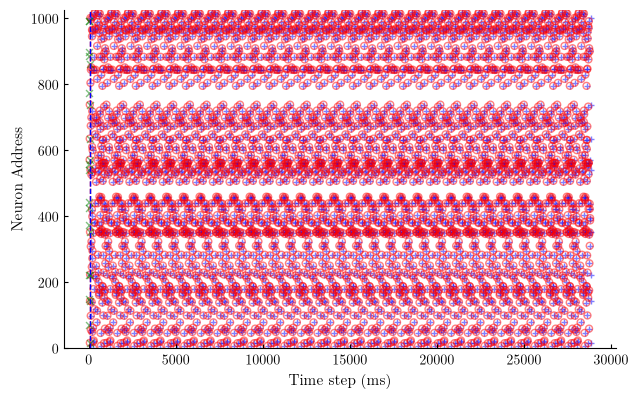
precision = 0.933        recall = 0.827  f1_score = 0.876
[13]:
target_full.shape, spikes.shape, input_spikes.shape
[13]:
(torch.Size([16, 1024, 28870]),
 torch.Size([16, 1024, 28870]),
 torch.Size([16, 1024, 28870]))
[14]:
fig, ax = plt.subplots()
splt.raster(spikes[opt.i_pattern, :opt.N_neuron_show, :].T, ax, s=25, c="blue", marker='+', alpha=.5)
splt.raster(target_full[opt.i_pattern, :opt.N_neuron_show, :].T, ax, s=25, facecolor='none', edgecolor='red',  marker='o', alpha=.5)
splt.raster(input_spikes[opt.i_pattern, :opt.N_neuron_show, :].T, ax, s=25, c="green", marker='x', alpha=.5)
ax.vlines([opt.N_pretime], 0, opt.N_neuron_show, 'r', ls='--')
ax.vlines([opt.N_pretime+opt.num_delay], 0, opt.N_neuron_show, 'b', ls='--')
ax.set_xlabel("Time step (ms)")
ax.set_ylabel("Neuron Address")
ax.set_ylim(-1., opt.N_neuron_show + 1.)
printfig(fig, 'periodic_spikes_noise', fig_width=opt.fig_width, fig_height=opt.fig_height, figpath=None)
spikes.shape, spikes[opt.i_pattern, :, :].sum().item(), target[opt.i_pattern, :, :].sum().item()
[14]:
(torch.Size([16, 1024, 28870]), 4863.0, 169.0)
[15]:
fig, ax = plt.subplots()
ax.plot(spikes.mean(dim=[0, 1]).cpu(), alpha=.2)
# ax.plot(spikes[opt.i_pattern, ...].mean(dim=0).cpu(), alpha=.7)
ax.set_xlabel("Time step (ms)")
ax.set_ylabel("Firing rate (Hz)")
printfig(fig, 'periodic_firing', fig_width=opt.fig_width, fig_height=opt.fig_height, figpath=None)
spikes.shape, target_full.shape
[15]:
(torch.Size([16, 1024, 28870]), torch.Size([16, 1024, 28870]))
Long-horizon replay under spike transmission failures
After a single seeded trigger window, each spike emitted by the network fails to reach the recurrent input with probability \(p_\mathrm{drop}\) (reset_spikes of forward_pass), at every step of the N_period periods of free replay. In the cascade picture, every spike of a motif is then a new ignition test, so that the replay survives \(t\) steps with probability \(e^{-h t}\), with the failure rate \(h\) of get_replay_hazard.
[ ]:
N_period = 100 # number of periods of free replay after the trigger window
# fewer levels and realisations than opt.N_scan and opt.N_cv: each run lasts about 70 s on MPS,
# so that the 25 runs of the sweep take about 30 min
N_scan, N_cv = 5, 5
# no failure, then log-spaced failure probabilities, from a lifetime of a few hundred periods
# down to a few periods (get_replay_hazard); changing this grid requires RECOMPUTE
p_drop = np.concatenate([[0.], np.geomspace(1e-4, 1e-1, N_scan - 1)])

def get_scores_drop(p_drop=p_drop, N_cv=N_cv, N_period=N_period):
    # the last num_delay bins of the motif repeat the first ones, so the chain has this period (bins)
    period = hd.opt.N_time - hd.opt.num_delay
    # the evoked window starts at phase num_delay of the motif, so every period is scored
    # against the same slice as the one-period score above
    target_evoked = target[:, :, hd.opt.num_delay:]
    t_evoked = hd.opt.N_pretime + hd.opt.num_delay
    scores_np = np.zeros((len(p_drop), N_cv, N_period, 3)) # precision, recall and F1 of each period
    i_start = 0
    if npy_filename.exists(): # resume after the last complete level: each realisation has its own seeds
        data = np.load(npy_filename)
        if data['scores_np'].shape == scores_np.shape:
            scores_np, i_start = data['scores_np'], int(data['n_done'])
    for i_scan in trange(i_start, len(p_drop)):
        for i_cv in range(N_cv):
            seed = hd.opt.seed + N_cv * i_scan + i_cv # one seed per realisation (nb 20 convention)
            with torch.no_grad():
                # seeded noisy trigger at the default p_flip, as for the one-period score above
                cue = hd.pattern_object(seed=seed)
                input_spikes = hd.get_input_spikes(target=cue, N_time=hd.opt.num_delay + N_period*period, seed=seed)
                # transmission failures: each spike emitted after the trigger window is removed from the
                # recurrent input with probability p_drop; drawn on the CPU on a seed stream of its own
                # (streams 1 and 2 are the flips and the spontaneous pad), then sent to the device
                generator = torch.Generator().manual_seed(int(np.random.SeedSequence([seed, 3]).generate_state(1)[0]))
                reset_spikes = torch.bernoulli(torch.full(input_spikes.shape, p_drop[i_scan]), generator=generator)
                reset_spikes[:, :, :t_evoked] = 0 # the trigger window is left intact
                _, _, spikes = hd.forward_pass(input_spikes, reset_spikes=reset_spikes.to(hd.opt.device))

                for i_period in range(N_period):
                    spikes_evoked = spikes[:, :, (t_evoked + i_period*period):(t_evoked + (i_period+1)*period)]
                    scores_np[i_scan, i_cv, i_period] = [score.item() for score in get_scores(spikes_evoked, target_evoked)]

        np.savez(npy_filename, p_drop=p_drop, scores_np=scores_np, n_done=i_scan + 1) # incremental save

    return scores_np

# the grid, the number of realisations and the length of the run belong to the cache key
npy_filename = data_cache / f"{hd.opt.datetag}_{exp}-drop_N_scan={N_scan}_N_cv={N_cv}_N_period={N_period}.npz"
lock_filename = npy_filename.with_suffix('.lock')
# RECOMPUTE = True
if RECOMPUTE:
    npy_filename.unlink(missing_ok=True) # FORCING RECOMPUTE
    lock_filename.unlink(missing_ok=True) # FORCING RECOMPUTE
try:
    data = np.load(npy_filename)
    scores_np = data['scores_np']
    if scores_np.shape != (N_scan, N_cv, N_period, 3) or int(data['n_done']) != N_scan:
        raise ValueError(f"Partial score file: {npy_filename}, resuming.")
    lock_filename.unlink(missing_ok=True) # in case the lock file was not unlinked
    print(f"Scores loaded from {npy_filename}")
except (FileNotFoundError, ValueError):
    with cache_lock(npy_filename) as acquired:
        if acquired:
            print(f"Score file not found or partial: {npy_filename}, evaluating the score.")
            ##################
            scores_np = get_scores_drop()
            ##################
        else:
            print(f"Score file is locked: {lock_filename}, passing.")
Score file not found or partial: ../cached_data/2026-09-07_periodic-drop_N_scan=5_N_cv=5_N_period=100.npz, evaluating the score.
100%|██████████| 5/5 [43:01<00:00, 516.39s/it]
[32]:
# F1 of each period against time: thin lines for the realisations, thick line for their mean, and
# dashed line for the theory: the replay of a motif survives t steps with probability exp(-h t)
# (get_replay_hazard), averaged over each period, with the precision and recall of the same period
# without failure (the motifs whose replay stops at a gap are already counted in them)
if not lock_filename.exists():
    period = opt.N_time - opt.num_delay
    period_s = period * 1e-3 # time steps of 1 ms: a period lasts about 1 s
    t_end = np.arange(1, N_period+1) * period_s # each period is plotted at the time it ends
    precision_0, recall_0 = scores_np[0, :, :, 0].mean(axis=0), scores_np[0, :, :, 1].mean(axis=0)
    t_steps = np.arange(N_period*period).reshape(N_period, period) # steps since the end of the trigger window
    hazard = get_replay_hazard(p_drop, p_A=opt.p_A, N_neuron=opt.N_neuron, num_delay=opt.num_delay,
                               lif_threshold=opt.lif_threshold)

    fig, ax = plt.subplots()
    colours = plt.cm.viridis(np.linspace(0, .9, N_scan))
    ax.axhline(0, color='0.7', ls='--', lw=0.8) # grey dashed guides at the extremal F1 values
    ax.axhline(1, color='0.7', ls='--', lw=0.8)
    for i_scan in range(N_scan):
        label = r'$p_\mathrm{drop} = 0$' if p_drop[i_scan] == 0 else rf'$p_\mathrm{{drop}} = 10^{{{np.log10(p_drop[i_scan]):.0f}}}$'
        ax.plot(t_end, scores_np[i_scan, :, :, 2].T, color=colours[i_scan], alpha=.4, lw=.4, rasterized=True)
        ax.plot(t_end, scores_np[i_scan, :, :, 2].mean(axis=0), color=colours[i_scan], lw=1.5, label=label)
        survival = np.exp(- hazard[i_scan] * t_steps).mean(axis=1)
        ax.plot(t_end, get_f1_from_ignition(survival, precision_0, recall_0), color=colours[i_scan], ls='--', lw=.8)
    ax.plot([], [], color='k', ls='--', lw=.8, label='theory')
    ax.set_xlabel("Time (s)")
    ax.set_ylabel(r"$F_1$-score")
    ax.set_xlim(0, t_end[-1])
    ax.set_ylim(-0.05, 1.05)
    ax.legend(loc='upper right', ncols=3, bbox_to_anchor=(.95, .975), handlelength=1.2, handletextpad=0.4, borderaxespad=0.2, labelspacing=0.3, columnspacing=1.)
    printfig(fig, 'periodic_scores', fig_width=opt.fig_width, fig_height=opt.fig_height)
Saving as ../figures/periodic_scores.pdf
Saving as ../figures/periodic_scores.png
Saving as ../figures/periodic_scores.svg